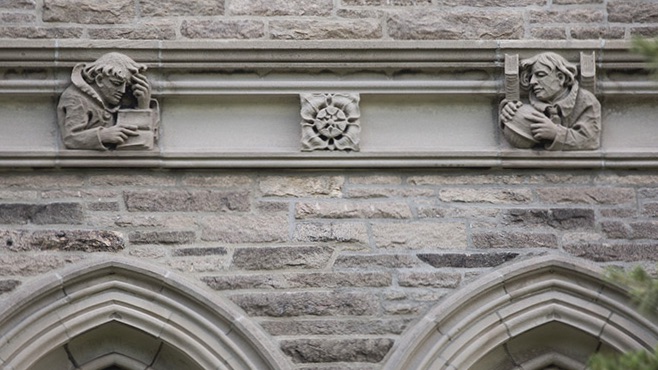
photo by Stephanie Mitchell
New Course!
Physics 1191 Foundations of Theoretical Physics
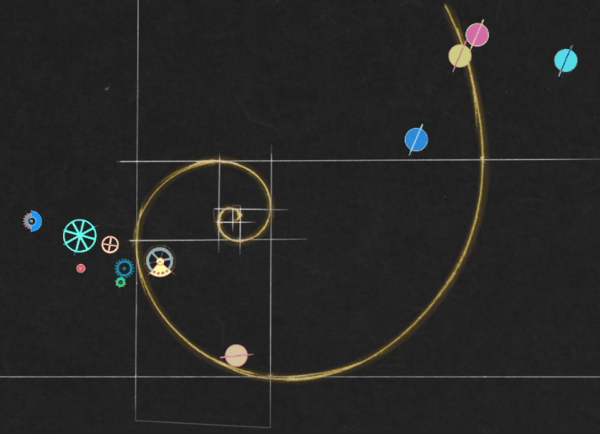
If you want to know what theoretical physics is really like, then this is the course for you! This course is designed for first-year physics majors want to get a broad view of foundational theoretical physics early-on in their studies. Also welcome are students at any level in other fields who like math and want to better understand physics for their own academic work or who seek a transitional step for switching majors.
A comprehensive and self-contained introduction to the conceptual and mathematical foundations of theoretical physics will be presented, centered on classical mechanics and later branching out to our subject’s five main areas: analytical dynamics, fields, statistical physics, relativity and quantum theory.
This course may be taken either as an alternative to Physics 1 (PHYS 1161) when co-registered with the lab course (PHYS 1192) or as an elective course without the lab. Ask me and your Academic Advisor for details.
My courses
| Fall 2025 | Physics 1151 Physics 1 for Engineering (Mechanics) Physics 1191 Foundations of Theoretical Physics |
| Spring 2026 | Physics 1155 Physics 2 for Engineering (Electromagnetism) Physics 3601 Classical Dynamics |
Why I focus on undergraduate teaching
I want to take part in the making of great stories. I believe that our college years coincide with a potential for breakthrough because we begin to think critically about the world without yet having to first think out of the proverbial box. These years can also be our most formative, provided we use this unique time in life to get to know ourselves well.
A great story begins whenever a student finds the courage to seize these opportunities, thereby empowering themself to pursue their own ideas in a personally gratifying and often influential way. I want to take part in the making of such stories by initiating a dialog with my students to help me get to know them better.
Equity in education
We educators are charged with the humbling task of preparing our students for an uncertain future. Our world is coping with the growing pains of its digital revolution. I believe that by promoting diversity in ways of thinking, we increase our chances of identifying solutions to the most vexing academic and social problems coming into view.
In the academic context, equity means embracing the diversity of ways people think about a problem. This attitude is natural for science in general, and has arguably been vital for physics in particular. Diverse thinking often shows up in students’ course work and is fairly easy to encourage. For example, by discussing in class a few of the different approaches taken in assignments, we demonstrate the value of unique work, we encourage continued efforts to think deeply about each problem, and we collectively enrich our understanding of the subject.
In the social context, equity in education means eliminating bullying in our institutions in order to maximize the flow of diverse ideas and to facilitate collaboration. This is particularly important to emphasize nowadays because of increasingly competitive academe. By being clear and outspoken about unethical conduct, we enrich our workplace and empower all members to do the same.
Use of in-class problems and student participation
I am exploring ways of integrating active-learning methods into my teaching.
Studies show, and I have witnessed myself, how collaborative in-class problem solving engages students throughout lecture and improves both their conceptual understanding and their working knowledge of physics.
See, for example, Deslauriers, Schelew & Wieman, “Improved learning in a large-enrollment physics class,” Science 332:862–4 (2011).
 Camille Gómez-Laberge